
Table of Contents
Shared Services Customer Engagement Contact
Glossary of Terms
Log-In to Peoplesoft HCM
View and verify employee Job and Personal Information
Managing Salary Employee Work Schedules
Reviewing and Resolving Time and Labor Exceptions
Modifying an Employee’s Timesheet
Approving Payable Time
Overtime
Reviewing Employee Absence Balances
Approving, Denying, and Reworking Absence Requests
How to View an Employee’s Absence Request History
Appendix A: Employee Leave Types
Appendix B: Time Administration Information
Time and Labor Exceptions List
Shared Services Customer Engagement Contact
For questions related to your Time, Labor, and Absence Management entries (I.e. – accruals, balances, leave requests, etc.), please contact your agency’s HR Department.
Other questions can be directed to the SSC Customer Engagement Team.
SSC Customer Engagement Phone: 877-340-5577
- An agent will answer the call and attempt to answer your question.
- If the question cannot be answered at that time, it will be escalated for research, and you will be given a ticket number.
- You will be contacted with a resolution.
SSC Customer Engagement Email: help@ssc.vccs.edu
- You will get an immediate response via email that the ticket is being worked.
- You will be contacted with a resolution.
Glossary of Terms
| Term | Definition |
| Absence Request | Currently known as Leave or an Absence Request. Requests for leave shall be approved by an employee’s manager. Refer to Appendix A for more information on VCCS Leave Plans. |
| Exceptions | Warnings generated by the system to inform employees and manager of possible Time & Labor errors. Exceptions will appear as a clock on the timesheet. Refer to Appendix B for more information on Time and Labor Exceptions. |
| Exempt Employee | Exempt employees are covered by FLSA but are specifically exempted from its minimum wage and overtime pay requirements. Exempt employees are required to record absence requests in PeopleSoft HCM. They are exempt from the overtime requirement. |
| Non-Exempt Employee | Non-Exempt employees are covered by FLSA rules and regulations. Non-Exempt employees are required to document all hours worked on their timesheet in PeopleSoft HCM. Additionally, non-exempt employees must record absence requests in PeopleSoft HCM. |
| Pay Period | A pay period is a recurring length of time that an employee’s time is recorded, processed, and paid. VCCS pay periods for Salaried employees are the 10th-24th and 25th-9th. Wage time periods run every other Friday – Thursday. |
| Payable Time | Summary of time worked by an employee to be processed through Time and Labor. The hours worked have been validated by the scheduled Time Administration process and have been checked for errors that impact PeopleSoft HCM processing. For more information about the Time Administration process, refer to Appendix B |
| Workweek | A workweek is a fixed and regularly scheduled period of seven consecutive 24-hour periods. (Friday to Thursday, Sunday to Saturday, Monday to Sunday). All Wage employees follow a Friday to Thursday workweek. |
| Elapsed Time Reporters | Employees who are required to enter time based on total hours worked in a day. (i.e.: 8 hours) The timesheet results will show the daily entries inserted by the employee. |
| Punch Time Reporters | Employees who are required to enter time each time they log in and out. The timesheet results will show the punch time entries inserted by the employee. |
Log-In to Peoplesoft HCM
Step 1. Log-in to PeopleSoft HCM through the MyVCCS website. This link to the MyVCCS website is also located at the bottom of the VCCS Home Page or through your agency’s login portal. Example of agency portal: MyBRCC, MyCVCC, etc.
Step 2. Log in using your MyVCCS Username and Password credentials.
Note: Some agencies refer to this as MyAgency Id such as MyBRCC, MyCVCC, etc. Username Example: xyz2596.
Step 3. Once signed on, select the HR Icon from your menu of tiles.
Step 4. Your page will automatically open to the Employee Home page. Click the drop-down arrow located in the upper left-hand corner of the page beside the Employee Home and select Manager Home.
End of Procedure
IMPORTANT NOTICE:
In PeopleSoft HCM you must use the program navigation buttons; the browser back and forward buttons should not be used! The use of HR on smartphones, tablets and other mobile devices is not supported.
View and verify employee Job and Personal Information
Step 1. On the Manager Home page, click the My Team tile.
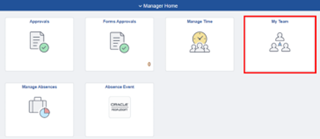
Step 2. On the upper left-hand side of the page, click the View Employee Personal Info link.
Step 3. A list of employees will populate.
Note: The default date is always the current date, to change this date, enter the date you wish to view the information as of in the As of Date field.
Step 4. Click the blue Refresh Employees button to the right of the date field.

Step 5. Note: A list of all employees that report to you will appear. This list will provide the employee’s name, employee ID, employee record number, pay status, and position number.
Step 6. Click the Select button beside the employee’s name.
Note: Here you can view the employee's information. You cannot change any information in the employee record.
Step 7. Click the View Employee Personal Info link located on the left-hand side of the page to return to employee listing. Select another employee or click the white back arrow link on the upper left-hand side to return to Manager Home.
End of Procedure
Additional Information:
Each manager should periodically verify that all their current employees are listed in PeopleSoft HCM under their respective reporting structure. Please contact your agency’s Human Resources Office if you cannot view your employees’ information or if corrections need to be made. Managers should be able to view the following data elements for each employee assigned to their respective work unit:
- Name.
- Job (official job title).
- Location Code (main work location).
- Home and mailing addresses.
- Email addresses.
- Phone numbers.
- Emergency contacts.
- Birthday.
- Compensation History (annual salary amount, hourly rate, or adjunct rate).
Managing Salary Employee Work Schedules
NOTE: Please refer to your agency’s internal policy for modifying work schedules or designating alternate work schedules.
Viewing the Employee’s Timesheet
Step 1. On the Manager Home page, click the Manage Time tile.

Step 2. The Timesheet Summary page allows you to make a selection for the employees that are assigned to you. Enter the desired information into the Selection Criterion Value fields.
You can click on the Get Employees button located at the top of the Employee selection Criteria box to see ALL employees assigned to your work unit.
OR
You can apply a filter (i.e., a 6-digit department number) in the Selection Criteria area and narrow down your search.
OR
You can enter a single Employee ID to view one employee.
Step 3. Click the Get Employees button located at the top of the Employee Selection Criteria box.
Step 4. Click the blue hyperlink of the employee’s last name to select the employee’s timesheet that you would like to view.
Step 5. The ViewBy field allows you to view the employee’s timesheet by Calendar Period, Day, or Week.
-
- Selecting Calendar Period always begins with the first day of the pay period.
- Selecting Day allows you to view any particular day of the Enter the month, day and year or select the date from the calendar.
- Selecting Week shows the week defaulting to begin on If you wish to change this, enter a date or use the calendar in the Date field located below the View By field.
Step 6. If you wish to see a Calendar Period, enter the begin date of the Calendar period or select Calendar Period from the drop-down arrow beside the ViewBy field and select the refresh button (two green arrows). By selecting the blue hyperlinks Previous Period or Next Period located to the right, you can view prior or future timesheets of the employee.

Step 7. For Elapsed Time Reporters (the employees who enter time in total hours worked). The timesheet results will show the daily entries inserted by the employee, the total number of hours worked for the week and the Time Reporting Code (TRC).

For Punch Time Reporters (employees who enter time each time they log in and out): The timesheet results will show the punch time entries inserted by the employee, the punch total number of hours worked for the week, and the Time Reporting Code (TRC).

Note 1: Best practice is to have employees enter time daily. Employees should never enter “0.00” (zero hours), on their timesheet. This would result in an exception. Once the pay period has closed, please contact your agency’s Human Resource Office for any necessary corrections to employee timesheets.
Note 2: All time worked should be recorded as REG – Regular Time. The Shared Services Center records Holiday hours per the agency’s holiday schedule. Please refer to your agency’s Human Resources Office internal policy regarding Inclement Weather.
Note 3: For Punch Time Reporters, if the employee works without a lunch break, the employee must put the end time in the “Out” field. Entering time in the Lunch field will NOT calculate your work time properly.
Step 8. The timesheet results will also show absence requests submitted by the employee. In the Status column, it will also show approved, denied, or push back. To take action on the employee’s absence request, you will need to follow the Absence Management instructions.
The example below shows a Punch Time Sheet with Regular hours submitted and one annual leave day requested and approved:
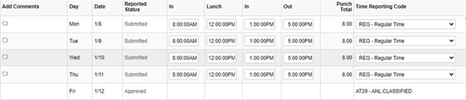
The example below shows an Elapsed Time Sheet with hours submitted, including one holiday and one annual leave request pending approval:

Step 9. If you see an exception icon (shown as a clock with exclamation mark) next to a particular day, please refer to Reviewing and Resolving Time and Labor Exceptions for more details.
Step 10. To view any comments made by the employee, click on the Comment icon (shown as a speech bubble) in the Add Comments section.
Step 11. The following information will be displayed below the timesheet by selecting the tab:
- Summary Tab - Reported Time Summary
- Selecting this tab will allow you to see the weekly summary of the employees’ work hours.
- Absence Tab – Absence Events
- Employee and Manager can view the specific absence request actions for the 14-day timesheet cycle.
- Exceptions Tab – Exceptions
- Employee and Manager can view any reported time exceptions which are generated when reported time is either incorrect, or the time does not comply with a defined rule. The exceptions displayed occurred within the timesheet dates and the associated recommended actions.
- Payable Time Tab – Payable Time
- The fields on this tab display any existing payable time within the date range specified for this timesheet.
Step 12. After reviewing the employee’s timesheet, you can use the links below the Reported Time Status section to return to select employee page or link to other time, labor and absence management pages.
End of Procedure
Additional Information:
- Wage, student, and work-study employees scheduled to work at least six consecutive hours must be afforded a lunch period (meal break) of at least 30 minutes a day as determined by the immediate manager. Therefore, the 30-minute lunch break must be incorporated into the work schedule.
Reviewing and Resolving Time and Labor Exceptions
Step 1. On the Manager Home page, click the Time and Absence Approvals tile.
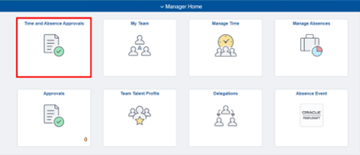
Step 2. In the upper left-hand side of the page, click the Exceptions link.
Step 3. This page allows you to make a selection for the employees that are assigned to you. Enter the desired information into the Value field.
- You can click on the Get Employees button located at the top of the Employee selection Criteria box to see ALL employees assigned to your work unit.
OR
- You can apply a filter (i.e., a 6-digit department number) in the Selection Criteria area and narrow down your search
OR
- You can enter a single EMPLOYEE ID to view one Entering a Group ID will show all employees within that group but not necessarily ALL employees that are assigned to you.
Step 4. Click the Get Employees button located at the top of the Employee selection Criteria box.
Step 5. Note: Employees with outstanding exceptions will be displayed. Time that has an exception with a Low or Medium severity level will still create payable time. Time that has an exception with a High severity level will not create payable time and must be resolved. Refer to Appendix B for a listing of all Exceptions.

Step 6. There will be three tabs populated above the employee data. Click the Details tab. This will allow you to view additional information/columns.
Step 7. Slide the scroll bar to the right until the column titled Explanation appears. Click the Explanation hyperlink to provide additional information related to this exception.
Note: Please contact your agency’s Human Resource Office for more information regarding Exception VX9013, Work-Study Authorized Amount Exceeded.
Step 8. Review the explanation and click the Return button.
Step 9. Some exceptions are allowable, but others require corrections to the timesheet.
Review the timesheet to determine the cause of the issue and take appropriate action to make necessary corrections if needed. Once corrections have been made, the automated Time Administration process should eliminate the exception.
If the timesheet does not require corrections, the exception can be allowed by clicking and placing a check mark in the Allow check box located on the Overview tab.
Step 10. Click the Save button. This will clear this exception from the employee’s timesheet.
End of Procedure
Modifying an Employee’s Timesheet
Please refer to your agency’s internal policy on modifying an employee’s timesheet before making any changes.
Making Changes to an Elapsed Timesheet
Step 1. On the Manager Home page, click the Manage Time tile.
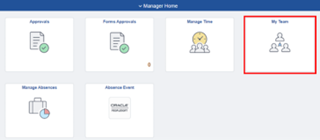
Step 2. The Timesheet Summary page allows you to select the employee timesheet that needs modification by entering the desired information into the Selection Criterion Value field.
- You can click on the Get Employees button located at the top of the Employee selection Criteria box to see ALL employees assigned to your work unit.
OR
- You can apply a filter (i.e., a 6-digit department number) in the Selection Criteria area and narrow down your search.
OR
- You can enter a single EMPLOYEE ID to view one Entering a Group ID will show all employees within that group but not necessarily ALL employees that are assigned to you.
Step 3. Click the Get Employees button located at the top of the Employee selection Criteria box.
Step 4. Click the blue hyperlink of the employee’s last name to select the employee’s timesheet that you would like to view.
Step 5. Check to see that the ViewBy and Date fields are correct. If not, make adjustments to ViewBy using the drop-down arrow to the right or use the calendar to the right of Date. Select the refresh button (two green arrows) next to the Date calendar icon.
Step 6. If the hours worked were completed incorrectly take the following actions to correct the data:
- Click in the cell with the wrong value.
- Remove the value.
- Enter the correct value.
- Click Submit.
Step 7. In the event the employee needs to record hours using more than one Time Reporting Code (TRC), click the Plus button located to the right of the timecard to add a new row. You will also need to choose which TRC from the Time Reporting Code drop-down field. For example, if there is a holiday loaded to the timesheet, a new row is needed to record REG hours.

Making Changes to a Punch Timesheet
Step 1. On the Manager Home page, click the Manage Time tile.
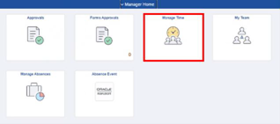
Step 2. The Timesheet Summary page allows you to select the employee timesheet that needs modification by entering the desired information into the Selection Criterion Value field.
- You can click on the Get Employees button located at the top of the Employee selection Criteria box to see ALL employees assigned to your work unit.
OR
- You can apply a filter (i.e., a 6-digit department number) in the Selection Criteria area and narrow down your search.
OR
- You can enter a single EMPLOYEE ID to view one Entering a Group ID will show all employees within that group but not necessarily ALL employees that are assigned to you.
Step 3. Click the Get Employees button located at the top of the Employee selection Criteria box.
Step 4. Click the blue hyperlink of the employee’s last name to select the employee’s timesheet that you would like to view.
Step 5. Check to see that the ViewBy and Date fields are correct. If not, make adjustments ViewBy using the drop-down arrow to the right or use the calendar to the right of Date. Select the refresh button (two green arrows) next to the Date calendar icon.
Step 6. If the hours worked or if AM or PM were entered incorrectly take the following actions to correct the data:
- Locate the cell with the wrong Value.
- Remove the Value.
- Enter the correct Value.
- Click Submit.
Step 7. If the entire day needs to be adjusted, take the following actions to correct the data:
- Click the Minus Button at the end of the row of that day.
- Confirm the deletion.
- Enter the correct hours.
- Click Submit.
Step 8. In the event the employee needs to record hours using more than one Time Reporting Code (TRC), click the Plus button located to the right of the timecard to add a new row. You will also need to choose which TRC from the Time Reporting Code drop-down field. For example, if there is a holiday loaded to the timesheet, a new row is needed to record REG hours.

Approving Payable Time
IMPORTANT NOTES:
- Payable time is defined as punch or elapsed time entries representing actual hours worked by the employee (REG hours) and previously submitted by the employee via the timesheet process.
- Payable time does not include leave requested and approved through the absence management process.
- Managers will not be able to view or approve all payable time until all exceptions have been resolved.
- Payable time is generated as the pre-scheduled Time Administration process runs. Please refer to the schedule in Appendix B for additional information.
Step 1. On the Manager Home page, click the Time and Absence Approvals tile.
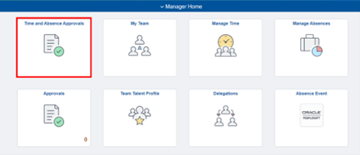
Step 2. In the upper left-hand side of the page, click the Payable Time link.
Step 3. The Approve Payable Time page allows you to select the employee timesheet that need modification by entering the desired information into the Selection Criterion Value field.
- You can click on the Get Employees button located at the top of the Employee selection Criteria box to see ALL employees assigned to your work unit.
OR
- You can apply a filter (i.e., a 6-digit department number) in the Selection Criteria area and narrow down your search.
OR
- You can enter a single Employee ID to view one Entering a Group ID will show all employees within that group but not necessarily ALL employees that are assigned to you.
Step 4. Enter the desired information into the Value field.
Step 5. Enter the desired information into the Start Date field.
Note: This is the start of the pay period requiring approval.
Step 6. Enter the desired information into the End Date field.
Note: This is the end of the pay period requiring approval.
Step 7. Click the Get Employees button located at the top of the Employee selection Criteria box. All employees that report to you will appear.
Step 8. Click the blue hyperlink of the employee’s name to view their Payable Time.
Step 9. Click the blue Select All link at the bottom left of the timecard above the Approve button.
This will allow you to select and approve time for all the dates listed. Use the box in the Select column on the left to choose specific days.
Please refer to your agency’s internal policy for timesheet and absence request submission and approval deadlines.
Note: Select “All” only if all time reported is accurate. If a negative (-) number shows in the payable time summary, it indicates that the employee made a change to their timesheet at some point during the current pay period. As long as the number of hours is the same, the positive and negative hours cancel each other out. The manager must make sure the employees’ time sheet is an accurate representation of hours worked for each day of the current time period or it will result in payable time errors for Payroll.
Note: You can select the Return to Approval Summary hyperlink (located under the Approve button) to return to the previous page or select the Next Employee hyperlink located to the right of the Start/End Date (underlined in red in screenshot above).
Step 10. However, if the time reported on the payable time screen is inaccurate, you will need to review the employee’s timesheet to determine the discrepancy. To access the employee’s timesheet, click on the Adjust Reported Time blue hyperlink to the right of the page.

Step 11. If the time reported on the payable time screen is correct, click the Approve button. A message box will appear. To confirm the approval, click the Yes button. Otherwise, click the No button to return to the previous page without updating the payable time status.
Note: Once the pay period has closed, please contact your agency’s Human Resource Office for any necessary corrections to employee timesheets.
Step 12. To review what you have just approved, use the following steps to access the Payable Time Detail screen:
- Go to the Manager Home page.
- Select the Manage Time tile.
- Select View Time.
- Select Payable Time Detail.
- Enter employee’s EMPLOYEE ID (EMPL ID ) # under Value and click Get Employees located at the top of the Employee selection Criteria box.
- Click on the blue hyperlink under the employee’s last name.
- Enter the Start Date of the pay period and the End Date of the pay period and select the Refresh button (two green arrows) next to the Date calendar icon.
- The number of payable work hours will appear for each day of the pay period; make sure there is a positive (+) number for each day worked under Quantity.
- Return to Approve Payable Time to approve the appropriate entries to result in the correct work time for each day for this employee.
REMINDER: Approved absence requests are NOT reflected in the Payable Time Detail, only actual hours worked.
Step 13. Click the blue Return to Select Employee hyperlink located on the bottom left of the Payable Time detail table.
End of Procedure
Overtime
Overtime is automatically calculated through Time and Labor, which is based on the definition of a workweek. The system does not allow users to enter Overtime for themselves.
Each college has designated one of the below as a default workweek, which could be Friday to Thursday, Monday to Sunday, or Sunday to Saturday. Please verify with your college Human Resources office as to what workweek your college follows.
Overtime Payment Configuration
When Overtime is calculated, it results in one of the following Time Reporting Codes (TRC).
Note: Overtime is calculated on the last day of the workweek according to the employees work schedule.
- OT1 – Comp Time Straight Time, considered Comp Time Pay. Comp Time Pay is calculated when an employee reports more than 40 hours during a workweek with a combination of TRC REG hours worked and another TRC, such as Emergency or Holiday. The employee does not physically work more than 40 hours during the workweek.
- Timesheet - The example below shows a timesheet for a workweek from Monday to Sunday with 43.7 total hours worked combining Holiday and Regular hours.

-
- Payable Time Detail- The example below shows Regular, and Holiday pay and details how the HCM system auto calculates the additional 3.7 hours reported as Overtime 1 (straight time).
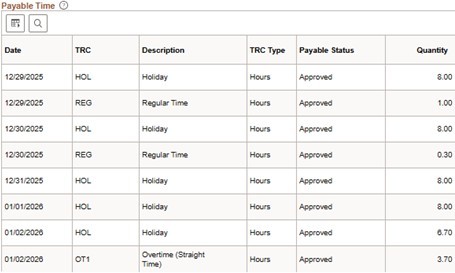
- OT2 – Overtime Pay, considered 1.5 times the hours. Overtime Pay is calculated when an employee physically works over 40 hours per (Workweek is Friday to Thursday in this example).
- Timesheet example below shows how Overtime 2 (1.5 times the hours) will be calculated when an employee physically works over 40 hours per workweek. The example below shows a punch timesheet for a workweek of Friday to Thursday with 00 hours worked.

-
- Payable Time Detail Table example below shows how the system calculates Overtime 2 when the employee physically worked over 40 hours during their work The example below shows the employee working 40.60 hours and the payable time detail reflects .60 hours of OT2 to be paid.

Reviewing Employee Absence Balances
Step 1. On the Manager Home page, click the Manage Absences tile.
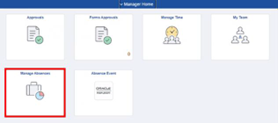
Step 2. In the upper left-hand side of the page, click the Absence Balances link.
Step 3. A list of employees that report to you will appear. Select the arrow located on the right-hand side of the employee’s box to view that employee’s balances.
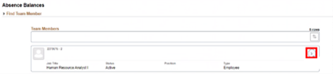
Step 4. Note: Here you can view the employees’ absence balances.
End of Procedure
Approving, Denying, and Reworking Absence Requests
Step 1. On the Manager Home page, click the Time and Absence Approvals tile.

Step 2. In the upper left-hand side of the page, click the Absence Requests link.
Step 3. Note: You can use the Show Requests by Status field to search for leave requests by Approved, Denied, or Pending status.
Step 4. All employees who have requested leave will be listed here and the manager acting on the request will select an employee name by clicking on the name hyperlink.
Step 5. Important Note: The balance shown is as of the last processed date. The current balances do not reflect unprocessed requests within the same leave period. The balance reflects the last time absence management was processed. The processing of absence management will coincide with pay periods. The employee's balance should not be off by more than one semi-monthly payroll cycle.
Managers should ensure that the employee has the available absence balances to allow the submitted absence requests to be processed without creating unpaid leave.
Step 6. Enter any appropriate comment in the Approver Comments field.
Step 7. Approvers can take one of the following three actions listed below:
Approve: The absence request is approved. The employee can view the approval by going back to their Self- Service Absence Request History.
Deny: The absence request has been denied. The manager should enter an appropriate comment notifying the employee of the reason for denial.
Note: A Denied Leave Request will be shown on the timesheet until the request has been cancelled by the employee.
Push Back: The request is neither approved nor denied. The manager needs additional information, or the request requires corrections. The manager should enter an appropriate comment to notify employee of the reason and specify any additional information or action needed.
End of Procedure
How to View an Employee’s Absence Request History
Step 1. On the Manager Home page, click the Manage Absences tile.
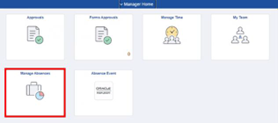
Step 2. In the upper left-hand side of the page, click the View Requests link.
Step 3. Select the arrow located on the right-hand side of the employee’s box and the screen will show the absence request submissions for this employee in chronological order.
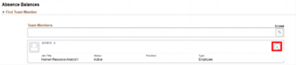
Step 4. To exit this page, select Manager Home.
End of Procedure
Appendix A: Employee Leave Types
When entering a leave/absence request, the employee will enter the start date and select the Absence Type from the drop-down menu. The employee will need to ensure they select the appropriate leave type corresponding to their specific leave plan. Choices will be Annual Leave, Other Leave, Traditional Sick/Personal Leave, and VSDP Sick/ Personal Leave. For a list of leave types and policies, please go to the Department of Human Resources Management (DHRM) website. For faculty members, please visit the Virginia Community College Policies website.
Standard Leave Types
Annual Leave type is dependent on employee status.
- 12-month Faculty Annual-New Plan.
- 12-month Faculty Annual-Old Plan.
- Classified Staff Annual Leave.
- Executive Staff-Traditional with greater than 15 years of service.
- Executive Staff-Traditional with less than 15years of service.
- Executive Staff-VSDP with greater than 15 years of service.
- Executive Staff-VSDP with less than 15 years of service.
Note: Excess Leave carried over to a new year requires agency approval but if you are eligible for and have Excess Annual Leave, those balances are not available as a selection in the Request Absence page but if you select your standard annual leave, PeopleSoft HCM will deduct the leave from the excess annual leave balance rather than from standard annual leave.
FML – Family Medical Leave
Employees will have the option to check a FML box when submitting their absence request with certain leave types. An employee should not select the FML field unless they have a qualifying event, approved by your agency’s Human Resource Office. If you have any questions regarding FML, contact your agency’s Human Resource Office.
Appendix B: Time Administration Information
Time and Labor Exceptions – Background Information:
The Time Administration process (Time Admin) is an automatic process which runs hourly according to the schedule for each agency and accepts any changes to the timesheets made by the employee. Each time the employee enters punch time entries or submits changes to those punch time entries on the timesheet, which deviate from the employee’s “predefined work schedule”, an exception is created. Also, if the manager has cleared the exceptions, and the employee submits changes to their timesheet after the manager has cleared exceptions, the system may create new exceptions.
The results of Time Administration are either exceptions or payable time that can be approved by the Manager. It is important that the manager resolve all exceptions before approving payable time. In the process of resolving or clearing the exceptions, the manager is to check the employee’s timesheet and absence requests for accuracy. Communication with the employee is essential to correcting punch and elapsed time entries and leave requests. It is the manager’s responsibility to ensure that the final timesheet is correct before approving payable time.
Moreover, a list of the exceptions is listed in Appendix B.
Time and Labor Exceptions List
The following table lists each exception, provides a description, whether the exception is allowable or not, the cause of the exception, the resolution (or action to take) and the exception’s severity level.
| Exception ID | Description | Allowable | Cause | Resolution | Severity |
| VX9001 | Reported hours less than scheduled hours. | Allowable | Timesheet incomplete or leave not loaded | Enter all payable and approved leave hours; allow if correct | Medium Severity. |
| VX9002 | Hours worked greater than 24 in a day. | Allowable | More than 24 hours reported in one day | Correct timesheet or allow if valid (e.g., leave payout) | High Severity. |
| VX9004 | Comp time required on holiday. | Allowable | Holiday not reported | Add holiday time or allow exception | High Severity. |
| VX9005 | Overtime required. | Allowable | More than 40 hours worked in a week | Report overtime when applicable | High Severity. |
| VX9006 | Late in punch. | Allowable | Punched in 5 minutes or more after scheduled time | Correct timesheet or allow exception | High Severity. |
| VX9007 | Late out punch. | Allowable | Punched out after scheduled time | Correct timesheet or allow exception | High Severity. |
| VX9008 | Missing punch. | Allowable | One or more punches missing | Correct the timesheet | High Severity. |
| VX9009 | 1200 hour limit warning. | Allowable | Wage employee reached 1200 hours | Allow exception to clear warning | Medium Severity. |
| VX9010 | 1500 hour limit reached. | Allowable | Wage employee reached 1500 hours | Correct timesheet or allow exception | High Severity. |
| VX9011 | Quasi full-time hours incorrect. | Allowable | Hours not between 32 and 39.9 | Correct the timesheet | High Severity. |
| VX9012 | Permanent part-time hours incorrect. | Allowable | Hours not between 20 and 31.9 | Correct the timesheet | High Severity. |
| VX9013 | Work-study authorization exceeded. | Allowable | Approved amount exceeded in SIS | Contact Financial Aid or HR | High Severity. |
| VX9014 | 9–11 month quasi full-time not 40 hours. | Not Allowable | Did not report 40 hours per week | Correct the timesheet | High Severity. |
| VX9015 | 9–11 month part-time over 32 hours. | Not Allowable | Reported more than 32 hours | Correct the timesheet | High Severity. |
| VX9016 | Lunch punch without out punch. | Allowable | Odd number of punches | Correct timesheet to be paid | High Severity. |
| TLX00030 | Inactive time reporter status. | Not Allowable | Time reporter status inactive | Update status to Active | High Severity. |
| TLX00440 | TRC not in TRC program. | Not Allowable | TRC not associated with reporter | Correct TRC program setup | High Severity. |
| TLX00830 | Invalid reported taskgroup. | Not Allowable | Department ID invalid for taskgroup | Correct taskgroup or department setup | High Severity. |
| TLX01560 | Quantity cannot be zero. | Not Allowable | Zero hours entered | Remove zeros or enter positive hours | High Severity. |
| TLX01600 | Invalid time reporter. | Not Allowable | Not enrolled in Time and Labor | Correct enrollment or reported date | High Severity. |
| TLX01700 | Full absence with reported time. | Not Allowable | Time entered on full-day absence | Remove reported time | Low Severity. |
